




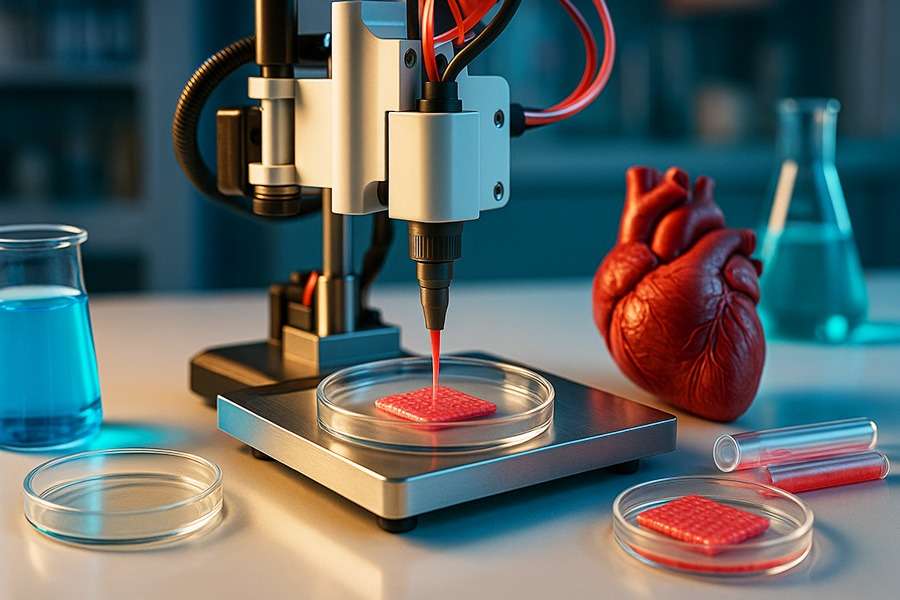
Bioprinting technologies are no longer science fiction. Today, scientists around the world use 3D printers to create living tissues, skin, cartilage, and even organ precursors. This is not only a revolution in medicine but also a chance to completely change the approach to transplantology, burn treatment, and drug testing.
What Is Bioprinting
Bioprinting is a three-dimensional printing technology that uses living cells instead of ink. Instead of plastic or metal, like in conventional 3D printers, bioprinters use bioinks — mixtures containing cells, nutrients, and supportive structures.
The printing happens layer by layer: the machine deposits cells in a strictly defined order and position to form tissue with the desired structure. After printing, the structure is placed in an incubator, where cells continue to divide and interact, turning into fully developed tissue.
Materials: What Is Used Instead of Plastic
To print tissues, the following are used:
- Hydrogels — soft materials that are convenient for “encapsulating” living cells.
- Bioinks — specially prepared mixtures that include different cell types (for example, fibroblasts, keratinocytes, stem cells).
- Scaffolds — frameworks that define the shape of the organ or tissue and gradually degrade, being replaced by living tissue.
The key requirement is compatibility with the body. The materials must not only avoid rejection but also support cell growth.
How Skin Is Printed
Skin is one of the “simplest” organs to print since it doesn’t have complex hollow structures like the liver or kidneys. However, printing skin is still a complex multi-stage process.
- Creating a skin model. All layers are taken into account: epidermis, dermis, and hypodermis.
- Loading bioinks. Different types of cells are used for different layers.
- Layer-by-layer printing. The bioprinter forms the structure with micron-level precision.
- Incubation. After printing, the tissue “matures” under controlled conditions.
- Testing and transplantation. The printed skin undergoes strength, elasticity, and compatibility tests.
Such skin is already being used to treat burns, especially in cases of extensive injuries where large replacement areas are needed.
How Other Tissues Are Created
Printing organs is more difficult than printing skin. It’s necessary to replicate not only the shape but also the internal structure, including blood vessels. However, there have already been significant successes:
- Cartilage — used to repair joints, noses, ears.
- Bone tissue — applied in maxillofacial surgery.
- Liver and kidney prototypes — currently used for drug testing.
- Vascular structures — attempts are being made to print capillaries and veins to supply blood within organs.
Scientists are working to ensure that printed organs can not only exist but also function fully inside a patient’s body.
Advantages of Bioprinting
The technology opens new horizons:
- Individual approach. Organs are printed considering the patient’s genetics, minimizing the risk of rejection.
- No need for donors. Bioprinting could solve the shortage of donors.
- Ethical testing. New drugs can be tested on bioprinted tissues without involving animals.
- Fewer complications. Artificial tissues often integrate better than donor ones.
Challenges
Despite the successes, the technology faces several challenges:
- Blood supply. It’s hard to recreate a vascular network, especially for organs.
- Immune response. Even “own” cells can trigger a reaction in the body.
- Tissue longevity. Not all bioinks maintain structure and function over time.
- Legislation and ethics. The lack of clear regulations slows down large-scale adoption.
Bioprinting Tomorrow: What’s Ahead
Research continues. In the coming years, we may see:
- The emergence of fully functional printed organs.
- Biofactories in hospitals, printing skin and tissues on-site for patients.
- Commercial production of tissues for pharmaceutical research.
- The creation of “hybrid” organs — with electronic components to monitor condition.
Bioprinting isn’t just another hype — it’s a real breakthrough in medicine. Printed skin already saves lives, and tissues help test drugs without harming animals. In the future, the technology could solve the organ shortage problem and make medicine more precise and humane. It still requires time, funding, and effort, but the direction is clear: bioprinting is the future.